Screen spline, flat splining and
other weird and wonderful shapes
Screen spline can often be reused when you repair a screen but sometimes you cant because the old stuff is in such bad shape. Or you might want to make your a new screen frame and just need to replace everything.
Spline is a available in quite a variety of shapes and sizes. The average hardware store stocks only a couple. Most likely the frame you have to work on requires the size they dont have.
Your local glass shop may well sell you the right size you need, just rememeber to bring a sample of the old that you removed so you can be sure to get the size right. If you still cant find the right size, try the links in the chart.
What types of splining are there ?
Splining comes in rolls that look like electrical wire, except it is solid all the way through. Often you will see "Polyfoam" which is like foam rubber except with very small air bubbles. It is available in sizes measured in decimals of an inch. For Example #140 is .140 of an inch.
The most common sizes or diameters in Southwestern Ontario, Canada, where I live are .160, .180, .200 and .250 inches diameter. I believe the above sizes are pretty common across North America too.
The sizes used depend on who the predominant supplier of windows was when most of the houses were built in your area.
The .250 size replaces the 1/4" aluminum spline that was used in houses built in the fifties and sixties. This size is particularly easy for the do it yourselfer to roll in.
Screen spline is made in many different materials . There is EPDM which is a kind of hard rubber, there is also hollow core vinyl. Hollow core vinyl can be stretched as you roll it in, which helps if the diameter is just a little too big for the frame you are working on. Polyfoam is best for the beginner though because it can be used in wider variety of frame styles and is easier to roll in.
There is also "T-spline" that is used a lot in the very thin frames used in aluminum storm doors. This is usually made of extruded vinyl and its cross section has the shape of a letter "T". It also is available in the same size descriptions as polyfoam.
When you roll this in you have to get the flat top of the letter T to lay down in the spline channel. That way it locks the material in place much more surely than regular polyfoam splining. With the T stuff however, you have to have exactly the right size, otherwise it just will not work.
Some window manufacturers have used weird and wonderful shapes in their custom screened doors in the past. Some of them have used glazing vinyl to hold the cloth in. Your local glass shop can probably help you sort out these situations and get you the right material.
Splining - Frequently Asked Questions
I get a lot of questions from visitors about splining so I have posted some of them below in the hopes that your own questions might be answered.
Splining Cedar screen doors
by Doug B
(Ottawa, On)
Sirs
I am constructing several cedar screen doors and would like to know the spline grove dimensions for .180" splining.
If the splining is .180" and I use aluminum screening what would be the correct grove width and depth?
Regards
Doug B
Hi Doug;
For
polyfoam, (The kind thats most often available at local hardware
stores )the groove is usually the same diameter as the splining.
Aluminum
screens either use a tapered groove, or a ridge at the top that kicks
in about .005 of an inch, as a means to stop the splining from rolling
out.
I would suggest cutting a test groove and consider
using ribbed splining 0.180" diameter. The ribs may offer more grip or
bite in a rectangular groove in wood.
Old aluminum and steel splining
by Jim P
I,m having problems figuring out how to replace the
screen on an Anderson screen window. It has no spline, and seems that
they use solid aluminum splining strips
Many companies used hollow square aluminum tubing and even solid 1/4" steel rod for spline back in the 1950's and 1960's.
You can replace the aluminum and steel spline with 1/4" diameter plastic, either polyfoam or vinyl.
To
remove the old, you will need to use a sharp awl and dig into a
corner of the screen frame to hook the aluminum out of the channel. Just make sure you have the plastic screen to replace it first !
Be glad to help if you cant find the right size splining locally.
Where can I find square screen splining
by Harry P
(Beaufort, SC)
I was looking for square vinyl, so far no luck. I have a piece of
it that a contractor brought over, it basically replaces really old
.180 spline where the .180 standard splining just rolls out of the
channel. Every heard of it or know where to get it?
Thanks
Harry
Old rope style screen splining
by David W
(Topeka, Kansas)
Hi
I am going to build some replacement screen windows for a
cabin. Instead of the traditional wood/wood molding the screen frame has
a mortise in the center and what appears to be a very narrow rope
material which holds the screen in place.
I need to copy this
technique as the restoration needs to be like others in the community.
Some old vacation cabins. My question is where do I buy the roping
material which fits into the mortise and secures the screen. The mortise
looks to be about 1/8 to 3/16 wide and maybe 3/8 to 1/2 deep.
Thank you
Hi David;
It
sounds like the builders of your cottage borrowed a technique from the
canoe and chair building industry. They used a channel and forced in a
rope or wooden splining to hold the screen in place.
Usually
I replace this with black polyfoam splining which is comes in diameters
of 0.160" all the way up to 0.250". The 0.250 inch diameter was a very
common size from the 1940's through the 1960's.
I can sell you a roll of 0.250 polyfoam spline.
If
you want to try your hand at the original rope technique you will
probably need to experiment with a few different sizes of rope. Boat
builders, especially those who build traditional wooden canoes would
probably know of suppliers for this material.
Spline selection
by Bill Karr
(Bradenton, Fl, USA)
Question:
How does one select the correct splining? I
replaced screening on a pool enclosure door. The old spline was flat. I
found it extremely difficult to insert new flat splining in one area of
the door and wondered if a round spline should have been used. Can the
type of splining required be determined by examining the splining slot? If
so and round is required, how does one determine size and smooth or
ribbed splining.
Answer:
If the original door
used flat splining then you need to use the same spline to replace it.
Some enclosures from the 1950's and 60's use flat "glazing vinyl"
instead of the round splining we use today.
T splining sources and installation
Where do I get T splining and are there any tricks or anything I should know about installing it?
Thanks, A.Brown Jr.
I
sell T splining, I just need to know the size you need. The picture shows
how T splining is installed with the T shape upside down where it locks
the splining into the channel.
What length does the T shape come in ? and how do i know what the Size is that i need ?
I
have T Splining in a few sizes that I can sell by the foot. You can also
buy it in 100 to 200 foot rolls as well as rolls with 1000 feet for
contractors.
The most common sizes that I find are .180 inch for sliding screen doors and .250 inch for storm door screens.
It
is made in .010 inch steps as follows: .160, .170, .180, .190 and so on
up to .250 inches. The size is measured across the width of the "T"
Rolling "Pet Screen" into patio extrusions with 5/16 flat splining.
by Taylor
(Laurens, South Carolina, USA)
Pet Screen installation is "ABSOLUTELY BRUTAL".
I'm building a
rather large porch using walls of patio aluminum extrusion, 5/16 flat
spline, and a product named "Pet-D-fence" 15 X 11, .025 material.
The
material does roll very tight into the spline groove but the strength
required to roll the spline in is incredible. I do roll the screen into
the groove before actually rolling in the spline. Lubricating with
saliva seems to help. I'll likely become de-hydrated before rolling-in
the planned 380 feet of spline, however.
I will not sacrifice
strength of the application just to make it easy. However, is there some
lube to use that will leave the rolled joint dry strong & tight for
the long term, and not degrade the spline material, screen material, or
aluminum powder coat?
Regards,
Don
Hi Don,
With
any screen material, the force required to roll the spline in is not
supposed to be excessive. You need to use a smaller spline than your
screen frames originally used because pet screen is much thicker.
The
size of spline you pick has to be a balance between ease of rolling in
and holding power. With pet screen, the material will be able to pull
out of the frame with enough force.
But that is generally an advantage because it can be rolled back in where normal screen would tear and have to be replaced.
The
only way to get ultimate holding power is to have the splining forced in
place in the factory with mechanical presses and special tooling. But
thats only prictical if you are making hundreds screens of the same
size.
One compromise might be to be use smaller pet screen
panels in the lower half of the screen porch and use regular screen
material in the upper panels where pets cant reach.
Flat screen bead splining
by Darren
I have an aluminum screendoor that has only screen on it no glass i
think its a larson it has a nearly flat screenbead that is one quarter
inch wide . it is not reusable and i cant find anything like it at the
local hardware store can you help?
Darren
If you can upload a picture of the splining I can check my catalogs.
Need a 3/8 inch flat splining for screen
by dee
(Trumbull, Ct)
Cant find it anywhere and need it fixed with in four days.
Flat plastic splining - took ours out of the front door and cant find any anywhere!
by Sue Lynn
(Wakefield, NH)
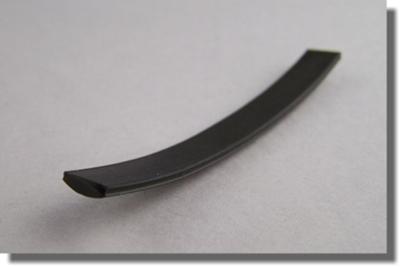
Have a metal screen/storm door that we took ripped screen out of, and now no one has the kind of splining we need to re-screen!
It's black, plastic, about 1/4 to 1/2 " wide and quite strong. do you have any idea where I can obtain more??
Where to get T-splining
for screen frames
by Steve
(Rochester, NY)
I have an aluminum sliding patio screen door. The old T splining seems to
be 11/64 (0.172) inch. Do you sell any such thing, or something else
that would suffice?
Right now I only need 2 inches of the stuff, but it would be nice to have enough to re-do the entire screen.
I
can buy 25 feet of 5/32 (0.156) t splining. Would that do? The only place
selling 11/64 t spline sells only 500 feet of the stuff.
For the 2 inch gap I want to fill, can I use round rubber splining?
Hi Steve;
With
T splining you have to use the size the frame was designed for. If you
use .156 in a frame designed for .171 the spline may push out too
easily.
I have .175 T splining and I can sell you 25 feet. $3.50 plus shipping. Let me know if you want me to send you some.
I want to change my screen material, but now the splining won't fit
by Terri M
(Lansdale, PA)
My dogs went through the last door with their claws. When I
bought a replacement, i bought screening that is pet resistant.
I
could put it into the door groove, but when i went to reuse the spline,
it won't fit. It's an odd shape anyway, it's built like a "T" on the
cross angle, not round like a straw or rope.
So I'm wondering if I
am best suited replacing the screening again with something that
matched old, or trying other splines out till I find one that may fit.
Hi
Terri, what you need is called T-spline and its available in many
different sizes. Usually when you replace your screen with petscreen,
you need a spline size thats slightly smaller than was used before. Call
me at 1-866-904-2383 and I will help figure out what size you need
Splining on outside?
We had a custom sized set of French doors replaced at our house, and
since the contractor did not get a screen door from the supplier, he had
another one made by a different contractor. The door works fine, but I
noticed that the splining is on the outside of the door. Is this common? I
have always seen them on the inside, as we are more concerned with it
looking nice from the exterior of the house.
Usually the splining is one the outside, but there are a few models as you have noticed, which have it on the inside.
It makes no difference in the operation and use of the door. Just which side you install the screen on when it is required.
I
Have a sliding screen door, trying to replace spline, the
opening is quarter of an inch. where could I find the
splining to fit the opening ?
I have 1/4 inch polyfoam. Let
me know what length you need. Send an email to the email address on the
home page of fixingscreens.com or phone me at 1-866-904-2383
Matching Mortise Size to Splining Size
Oakville ON, Canada
Strong winds off Lake Huron occasionally tear large fibreglass screens out of their wooden frames on the screened porch at my summer home. The screens are stapled to the frames and have a wooden moulding nailed on top. The problem recurs despite large numbers of closely spaced staples and nails.
For future repairs I plan to rout a channel into the wooden frames and secure the screens with splining before replacing the mouldings. This strikes me as probably much stronger and less likely to tear.
My concern is to properly match the the size and material of the splining with the width and depth of the routed mortise in the wood. Should the splining be the same size as the slot, a bit smaller for snugness or larger to allow for the screen thickness? Router bits usually come in sixteenth inch gradations - 1/8", 3/16" or 1/4". What do you recommend for both slot size and splining size and material?
Have any questions about screen spline
Need to know anything about spline ? Have some pictures of spline that you need identified ? Share them here
What Other Visitors Have Said
Click below to see contributions from other visitors to this page...
Where to find T Moulding, T Gasket or T Spline 
I have an old pool table made by sears that has a T spline, holding the cloth on the top rails. This is a weird design I have never seen on any other …
Need to know different sizes of Black Flat Spline
Hi,
My screen has what might be an odd ball size of Black Flat Spline width is .2625" by .081" thick about 17/64" by a little more then 5/64" I believe …
Vintage windows with metal screen spline
I'm wanting to replace the screens for vintage metal casement windows. I have the screen frames. Originally they had metal splines. I'm told I need 3/8" …
Could I split the spline lengthwise?
I am trying to put pet screen in an old aluminum frame screen door. The smallest spline I could get was .14. The spline fits in the channel on its own …
Screen Porch replacement spine size
I bought a house with a screened in Porch and need to replace some screen, I can't fiqure out what size spline I need. I've attached images in hopes that …
Odd flat screen spline
My old flat spline measures .280 x.062 and I can’t find it anywhere.
I tried using round and it works it way out over time.
Where can I find this …
What size spline to use ?
I just replaced my aluminum screen with fiberglass screen. The old spline was solid and measured 3/16" with a 3/16" channel. I purchased Pro-Line 0.185 …
Pet Screen - T-Spline options?
I need to replace our sliding screen door screen with pet screen. I know a you're supposed to step down a size or two in spline, but the current spline …
Lisa aka screen queen
I have a Anderson screen door that had a 5/16th hard plastic spline with grooves on both sides. I cant seem to find this spline anywhere. The last order …
Cannot find correct size spline
Hello - I am trying to rescreen some 1995 RV screens. .12 spline won't work as it is such a tight fit, the screen rips in multiple locations. I ordered …
1960s? Screen Door Spline
In the process of refinishing my front door and aluminum storm / screen door.
Screen door has a rigid (but somewhat pliable) spline. May be vinyl? …
Screen cloth blows out with high winds
Hello,
About 3 years ago we had a screen room built using extruded aluminum framing. This framing is extruded with a channel that measure 0.139" x …
Does this need T spline ?
I have changed out window screens in the past but, this one is giving me a very tough time! I was unaware that there was a 'flat' spline... Is that what …
Round spline wont go in square hole
I have changed out window screens in the past but, this one is giving me a very tough time! I was unaware that there was a 'flat' spline... Is that what …
3/8 or .375 Flat Spline
Anyone know where to find 3/8 or .375 wide flat spline, door is newer, but I still can't find it. Any suggestions?
Dovetail Groove and Spline
Much like the poster above I have a similar wood related question.
I am working on a historic home and I have to use wood for the frames of my screen …
What kind of spline/screen is this?! CANNOT find a replacement....
I have a few damaged retractable screens that I need to replace. What's really strange is that the "spline" basically has 2 flaps and the screen mesh is …
Problem finding correct spline
I removed old spline (flat type) from a 1/8 inch channel. I am using regular aluminum screening. Where do I find the correct size and type of spline? …
Who makes this flat spline
Looking for odd shaped spline for gold door. A spline is missing from one section.
T spline size
Trying to replace the screen on my sliding door and I'm having trouble finding T spline anywhere. Not sure the exact size I'd need either. I printed …
Help with measuring and ordering spline
Hello!
We live in an older house and it has these metal screen frames that hook into 2 brackets at the top and then have 2 latches at the bottom to …
T spline for Larson all screen doors?
I see a post above asking what kind of T spline is needed for a Larson screen door. You asked him to send a photo, but I can't see whether that was done. …
Think I need T Spline
I need T spline like that in the attached picture. Based on my caliper measurements, the T is 0.165 inches tall, and 0.170 inches wide. Would any of …
Old Pella sliding screen door
We have an old Pella sliding screen door that is from the early 80's. It has a rectangular spline that I cannot find anywhere. I would like to fix the …
Direction of screen spline?
Hi - I recently ordered new aluminum-framed screens for my screen porch. The openings were out of square so the measurements of all 4 sides are different. …
T-Spline for holding in window screens
Hi, I need 1/8 inch t-spline. that would be 0.125 I think. Can you help?
Thanks
Hi Dalinda;
T spline is called that because it is shaped like a …
Anderson Window Screen Spline
We have several new replacement windows made by Anderson. Two of the screens were recently torn by our new dog. The spline is white aluminum square stock. …
Can't find correct flat spline!!
Hello,
I live in rural PA in a home built in the early 1990's & am trying to find replacement spline for my screen door (replaceable screen/storm door) …
Which way should the spline go
Could you please tell me which way the spline should go on a screen window, does it face the outside or inside of the house.
Thank you very much
Mary …
Spline won't stay
I have 2 spots in my Arizona room (screen room) that keep coming out. It's on the outside and I have replaced the spline, thinking it might have had sun …
Can round #window #screen spline fit where flat spline is used
I want to replace my patio screening, and the old spline is flat.
I have a hard time installing flat spline.
Can I use round instead? .190
Thanks. …
New way to make screen spline
I have a an older patio door that uses a size spline larger than the usual .18 that I can get at Rona. That size works well when installing metal screen, …
Not Very Handy
I have a large sliding screen door and have tried to replace the screen but CANNOT for the life of me, get the spline to stay on the track. I bought the …
Spline for flexible plastic windows
Trying to replace plastic in a florida sun room. Tried round splines, but I can't get wrinkles out of plastic. I think the problem is that I need new …
Removing old brittle #screen spline
Hi,
I need help. I want to chance my patio screen but the spline it's too old and with exposure to the sun, heat and water from the outside it has …
Small #spline to fit vintage trailers and Hehr #windows
We are A & P Vintage Trailer Works, Inc., in Paradise, Texas. I am currently working on a 1961 Boles Aero Trailer, that has Hehr windows. This particular …
Screen #spline keeps coming out
I have a sliding screen door whose nylon screen has started coming out twice now. I repaired it in the past just by reinserting the spline. Was that a …
Metal screens are too tight in the groove
I recently built a screen porch for my mom.
I made frames for the screens to match some existing ones that have a groove 1/8" wide by 1/2" deep. …
How do I secure screen to prevent stinking kitten from pushing corner out
Usually have one fat white kitten and one skinny white kitten sitting side by side on the patio.
Noticed the fat one huddled in the corner having an …
Awesome #DIY Tip Spline for filling cracks in #floors
I have cracks in a portion of my 1920's wood flood from a bad patch job where the replacement boards were not made with tongue and groove boards like the …
Pool Enclosure Flat Spline
I have a Florida aluminum pool enclosure built around 1990. I replaced a lower panel with a pet screen when our German Shepherd ran through it chasing …
Fed up with Fido
Replaced the screen on a sliding patio door last weekend. Dog has not ripped the screen, but this weekend she pushed on the screen hard enough to push …
Pet Screen and Emco (Anderson) Forever Screen Doors
We have three cats that love to tear up our screens. I bought some Pet Screen only to find (when I tried to install it) that our screen door (made by Emco …
Old Storm Door Spline Not rated yet
I have an old storm door that I need 5/16 inch screen spline in grey. Where can this be found?
Hi David;
Its hard to tell without some pictures …
Replacing V-spline Not rated yet
First I'd like to thank you for being here, your a wonderful source of information. I am replacing the screens in sliding panels of my pool enclosure. …
Screen Spline for Four Wind Motorhome RV Not rated yet
I have a 1996 Four Winds 24ft motorhome with a busted-out screen. I know how to rescreen a screen frame, but I can't find the right spline for this screen …
V shaped spline in my RV Not rated yet
I am replacing the screen on an 5-th wheel rv. The original spline was V shaped. No one seems to know what it is nor how to replace it. Can you help? …
Florida Screen Porch Not rated yet
I lost some screening on my porch in Hurricane Irma and I am trying to replace. The screens that blew out were put in with round spline which I don't think …
Strange spline shape Not rated yet
I'm hoping you can help me. we need to replace the screens on our screened in porch. We are not able to reuse the spline as it is no longer in long pieces. …
Metal spine replacement with vinyl? Not rated yet
I want to replace the screen in Anderson windows, but they use a metal u shaped spline. These windows were purchased in the mid 1988's. I will replace …
What are most common spline sizes? Not rated yet
If I was to stock 2 or 3 of the most common sizes for window and door screens, what would they be?
0.160 and 0.180 round polyfoam are the most common …
Can Not Find Spline!! Not rated yet
Hello,
I live in rural PA in a home built in the early 1990's & am trying to find replacement spline for my screen door (replaceable screen/storm door) …
Home Made Wood Screen Frames Not rated yet
I live on a small island in the Caribbean with few resources. I am building some window & door screens with wood frames and will routing a groove in the …
Rolling in T shaped screen #spline Not rated yet
My question is about rolling in the t spline. Your diagram shows the roller blade on the side of the grove next to the frame and it looks like you use …
.250 1/4" flat black spline Not rated yet
Hi,
Cannot seem to find spline with this same sizes and in flat. We want to redo a screen in our screen room. Do you have any? Or is there a replacement? …
Will use no #spline before its time Not rated yet
I have some hand-me-down gray hollow core smooth spline, at least that's what i think it is. I have had it for so long that I wasn't even sure it was splining. …
Hatch screens for private #yacht Not rated yet
My wife Joyce and I live aboard a 40 ft sail boat. I must fabricate insect screens for four deck hatches. As I must access hatch latches from inside, …
Dear Lanai in Florida your screens wont blow away Not rated yet
I built a lanai and was given round spline at the store. A handyman said we should have used flat spline and our screens will evidently pop out😞 is this …
Need T Spline Not rated yet
Hello,
Bought older RV and bottom portion of screen door is damaged/missing. Removed remaining spline and found what appears to be 0.190" T Spline. …
Glazing Vinyl not right size Not rated yet
I have a home with old style track storm windows installed over
single hung windows.
I am looking for splining material to repair some broken glass. …
Spline for 1983 screen enclosure Not rated yet
Hello,
We had our screened pool enclosure re-screened and the contractor mentioned something about the spline used in the enclosure that was installed …
Replacing 1/4" aluminum spline Not rated yet
I am replacing the aluminum screens in my older house with fibreglass screens. The old screen was held into a 1/4" groove with what looks like 1/4" aluminum …
To Cut or Not to Cut ? #Shakespeare screen repair Not rated yet
I just replaced the screen on my screen door and put the same spline in that was in it before. The problem is I have about 5 or 6 inches of extra spline …
Spline temperature limit Not rated yet
Wanted to use some vinyl spline as an insulation ony smoker door ... what temp do u think that it can handle ?
The melting point of screen spline is …
What size spline? Not rated yet
Hi! I have two older sliding screen doors. They had metal screens but I am trying to replace them with fibreglass... none of the screen splines that I …
Screen spline roller groove too small Not rated yet
The roller's groove is always much too small for any spline, why don't they make a fat groove roller.
Round equivalence of 30.48 flat screen spline Not rated yet
I am replacing a couple of Florida glass panels of our pool cage. I am using pouch of 100 ft. flat screen spline my neighbor gave me. It is still flexible, …
Help with Spline Size Not rated yet
I am looking for the exact screen spline that you have in the picture on the bottom of your
Screen Spline Information page. It reads "Here's an example …
Old 6 foot sliding door needs new screen Not rated yet
Our problem is the inside of the groove (mortise) for the spline is large and odd-shaped and the opening is 5/16" wide. While viewing the Rt side of the …
screens get cut when rolling in the spline Not rated yet
I have replaced the screens on the door on the backporch three times trying to find one in which the screens won't pull out so easily. I have the little …
What kind of #window spline stands up to cold weather ? Not rated yet
Wonder if u know a type of spline that u can use in cold weather?
Hi Freddy;
Some types of spline are made from EPDM which is also called synthetic …
Glass block hopper vent window Not rated yet
Our dogs ripped the screen out of one of our vent windows to our basement and I am trying to replace the spline that miraculously disappeared as well. …
breaking spline Not rated yet
We are trying to replace the screens in two patio doors.
The spline will not come out of the groove. We tried to remove it with a small screwdriver and …
flat spline Not rated yet
Im am having a very hard time putting the flat spline in my screen door its the same size that was in there but I cant seem to get it started but sides …
Dont reuse old spline when using Petscreen Not rated yet
I put pet screen in and it was brutal . I reused the old splining . I think I have the 1/8 splining and did not see any smaller size at hardware store.Is …
Flat black spline, similar to Sue Lynns' Not rated yet
Good Day,
I'm trying to replace the screening to a metal frame and I'm having difficulty finding the flat black stiff spline.
I need about 10 ft. I …
U shaped flat screen spline Not rated yet
I teach high school home main and we did a screen repair for teachers. Students tore out damage screens before I check them and 1 had a spline that I …
Size of slot for spline Not rated yet
I made a wooden screen door for a very damp location, but it kept rotting out.
I am now making one out of fiberglass but I have to use spline to install …