- Home Page
- Spline
Screen Spline Information
Very often when you repair a screen you can reuse the old spline. But there are occasions when you cant because the old stuff is in such bad shape. Or, you might want to make a whole new screen frame with all new materials. You might also encounter old style flat screen splining or even aluminum or steel splining and need to replace it with something more easily available
Splining is available in quite a variety of shapes and sizes for the window industry. The average hardware store or even big box store, stocks only a couple of sizes. Most likely the frame you have to work on requires the size they dont have.
Types of Spline Materials
- Round Polyfoam
- Round EPDM
- Round Hollow or Solid Core Vinyl
- Vinyl "T" Splining
- Flat Screen Splining
- Square Aluminum
- Round Steel
Prepackaged screen splining
I have prepacked screen bead in a variety of sizes for sale. The packages are all 25 feet long which is the ideal length you need for screen doors up to 48 inches wide x 7 feet or 84 inches high.
You can also find it in the big box stores but usually its only 0.160 and 0.180 diameter Polyfoam, and only 20 feet instead of 25. This is fine if your windows are relatively new but what if your house was built in the fities or sixties, or your windows are on a boat or motorhome ?
Shown below is tiny 3/32" diameter EPDM spline, a hard to find small diameter spline used by motorhome builders like Beaver and Airstream and many others.
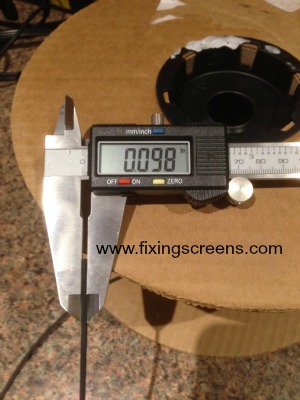
I have sizes such as 0.250 or 1/4" diameter polyfoam, which is great for fixing old frames from the 1950's and 1960's. There is also "T" spline which is often used in the thin screen frames found in storm doors and flat spline most commonly used in screen porches.
Shipping and handling for my prepackaged spline within the Continental United States and Canada is included with the price. All shipments are by mail, by parcel post. Extra charges apply if you need me to ship anywhere else in the world.
If you need longer lengths or sizes that are not listed here, just ask !
In the drop down box above there are many different types of spline listed.
0.120" Polyfoam is the thinnest I can find, plus its foam rubber so you can compress it into smaller spline grooves to some extent. I also have 0.120" diameter ribbed gray epdm which is harder than than the polyfoam but often used in RV screens.
0.160" diameter polyfoam and 0.180" diameter polyfoam are the sizes you find in Home Depot or Lowes or other big hardware stores. I sell polyfoam because often the big box stores often only have hard epdm rubber or PVC in these sizes. The harder plastic does not always fit with every screen frame.
0.250" and 0.270" are large diameter polyfoam spline used to replace the steel and aluminum spline you see in windows from the 1940's through to the early 1960's.
I also have Black PVC plastic T spline in several sizes. which is used a lot in aluminum storm windows and doors as well as with many modern window and door manufacturers.
The dropdown list also shows flat spline often used in screen enclosures and some old patio screen doors.
If there is anything you need that you dont see here. Just ask, I will try to find it or refer you to someone who might have it.
Round Polyfoam
Splining comes in rolls that look like electrical wire, except it is solid all the way through. In the big box stores you will most often see "Polyfoam" which is like foam rubber except with very small air bubbles. It is available in sizes measured in decimals of an inch. For Example #140 is .140 of an inch. Polyfoam is the the easiest for the novice to work with.
The most common sizes or diameters in Southwestern Ontario, Canada, where I live are .160, .180, .200 and .250 inches diameter. I believe the above sizes are pretty common across North America too. The sizes used depend on who the predominant supplier of windows was when most of the houses were built in your area.
The .250 size replaces the 1/4" aluminum that was used in houses built in the fifties and sixties. This size is particularly easy for the do-it-yourselfer to roll in.
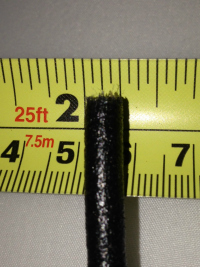 |
0.250" and 0.270" are large diameter polyfoam splines used to replace the steel and aluminum spline you find in windows built from the 1940's through to the early 1960's. The Picture to the right shows 0.250" spline. (There is a little shadow to the right so the spline looks a little bigger than it actually is ) |
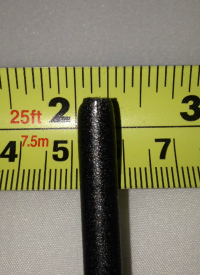 |
This picture shows .270" spline. It is the largest round spline I can find for window use. You can get larger sizes of foam rod but these are not window spline, they are intended for gap filling and do not have UV resistance. They will get brittle in the sun. |
Round EPDM
Splining is made in many different materials . There is EPDM which is a kind of very flexible rubber with added chemicals to make it UV resistant. EPDM is a longer lasting material than the polyfoam, but like all plastics, it can become brittle with exposure to the sun.
One useful property of EPDM splining, is that you can stretch it a little as you roll it in the spline channel, making it easier to roll in. EPDM is more commonly seen in screens with very small spline diameters like .120"
There is also hollow core vinyl. Hollow core vinyl can be stretched as you roll it in like EPDM. This helps if the diameter is just a little too big for the frame you are working on. Polyfoam is best for the beginner though because it can be used in wider variety of frame styles and is easier to roll in.
"T" Splining
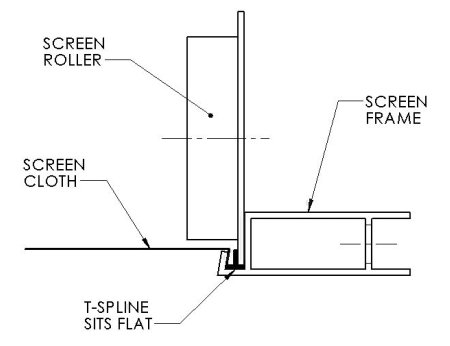
There is also "T-splining" that is used a lot in the very thin screen frames used in aluminum storm doors. This is usually made of extruded vinyl and its cross section has the shape of a letter "T". It also is available in the same size descriptions as polyfoam.
When you roll this in you have to get the flat top of the letter T to lay down in the splining channel. That way it locks the screen material in place much more surely than regular polyfoam splining. With the T stuff however, you have to have exactly the right size, otherwise it just will not work.
Most "T" splining is Black coloured Vinyl. In the past some window manufacturers used white vinyl. Trouble is, the white vinyl became so brittle in the sun so that when you try to remove it, it just turns to powder!. If you have white vinyl splining to replace, count on spending quite a while to scrape it out.
Flat screen splining and
other strange shapes
Some window manufacturers have used weird and wonderful shapes in their custom screen doors in the past. Many screen doors built in the 1950's used flat gray vinyl to hold the screen in. Flat screen splining is not easily available but in some cases you can substitute "glazing stop" vinyl and it will work fine.
Glazing stop vinyl is normally used to cover the edges of the exposed glass around the perimeter of aluminum windows. Check with your local glass shop to see if they have glazing stop vinyl similar in size and shape to your flat screen splining.
Other shapes you may run into are hollow 1/4" square aluminum used in windows from the sixties. This can easily be replaced with 1/4" diameter round polyfoam splining.
Some screens from the 1940's used round steel bars to hold the steel screen cloth in. This is certainly reusable if you don't mind hammering it back in again. No question these screens are 10 times stronger than anything available today.
Personally though I find its easiest to replace the steel with 1/4" diameter polyfoam and regular fiberglass screening.
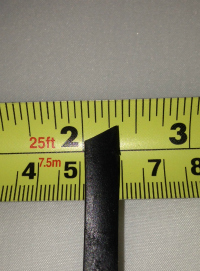 |
This is flat screen spline, 3/32" thick x 5/16" wide. Often used in screen porches. This style is curved on top and flat underneath The link below is for a 500ft roll commonly used if you are replacing screens on a pool lanai |
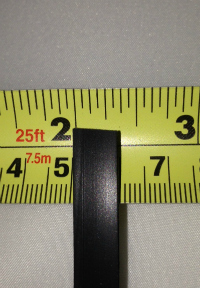 |
Here is another flat spline, slightly wider than the one above. This one measures 3/32" x 11/32". It is also used in screen porches. The difference in width is only 1/32" of an inch wider than the flat spline above. |
What size do I need ?
Do you need to identify what size you need ? If you have a piece of the old splining you can compare it with this downloadable screen size chart. Just click on the link below and print it out and compare your sample with the sizes shown.
Spline Size Chart
(Downloadable PDF)
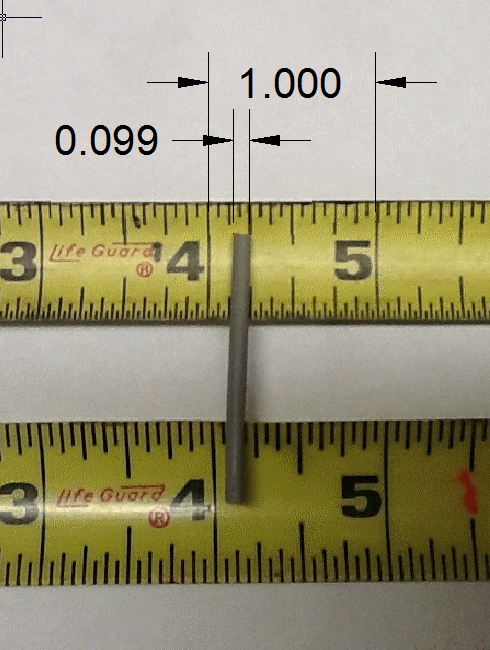
You can also send me a digital picture. The best way is to send a picture with a piece of old splining lying on a measuring tape. As long as I can read the measuring tape, I can measure your splining from the picture very accurately.
Here's an example of a piece of screen splining from an Airstream trailer. By using the tape measure as a reference, I can figure out the size of the spline.
Have any questions about splining ?
Maybe you are repairing a frame and need to know how to roll the splining in, or perhaps are looking for a hard to to find. I have put together a collection of questions and answers on my screen spline frequently asked questions page.